Showing posts with label Newbery Award. Show all posts

Friday, November 25, 2011

Adventure classics -- Tessering with strangers


A Wrinkle in Time

by Madeleine L’Engle

#

It’s not true that all books with the strength to become classics faced rejection. It just seems that way. Still, learning that more than two dozen publishers rejected A Wrinkle in Time, Madeleine L’Engle’s 1962 blend of science fiction and fantasy, amazed me. Still more amazing -- some Christian schools also banned Wrinkle and other books by the overtly Christian L’Engle from their classrooms.

Why? Some of her obituaries (and the popular culture site Hollywood Jesus --
www.live.hollywoodjesus.com/ ) blame her advocacy of universal salvation, the belief, as she wrote, that “all will be redeemed in God’s fullness of time.”

I think the more likely reason for the book’s initial rejections was that publishers in the early 1960’s just found it baffling. What begins as an apparently realistic novel for children -- what publishers would characterize today as young adult -- changes shape into an exploration of time and space through the semi-scientific concept of a “tesseract” -- explained in the book as a wrinkle in the time-space continuum.

And the guides through this wrinkling are a trio of old women who look like the popular conception of witches. And then, of course, there was a psychic known as the Happy Medium who reads the future -- kind of -- with her crystal ball.

So is Wrinkle science fiction or fantasy or Satanism? In a world now aware that Harry Potter is less about wizardry than the struggle between good and evil and that even Gandalf was an angel in disguise, it’s hard to imagine anyone mistaking Mrs. Whatsit, Mrs. Who and Mrs. Which -- the beings who guide heroine Meg Murry and her fellow time/space travelers -- for minions of evil.

But publishers, parents and schools in 1962 may well have wondered how American kids in a country still reeling from McCarthyism and the sting of losing round one of the race for space to the Soviet Union were supposed to know the difference. Even the review from Horn Book, one of the most prestigious guide’s to children’s literature, noted that the rewards offered by A Wrinkle in Time were the result of its “unusual demands on the imagination.”

Madeleine L'Engle
Somehow, L’Engle’s readers managed to sort things out. Wrinkle won a Newbery award (given by a division of the American Library Association) the year after its publication. And L’Engle went on to write a multi-part series about the family of its heroine Meg and her future husband, Calvin O’Keefe. And kids (as well as the cast of the TV series Lost) kept reading.

(Next Friday, a December of spirited adventure opens with “The Light Princess,” a tale of a heroine who lost one of womanhood’s least appreciated assets -- gravity. By L’Engle’s influence and fellow universalist, George MacDonald.)

Friday, September 16, 2011

Adventure classics -- Last woman left standing


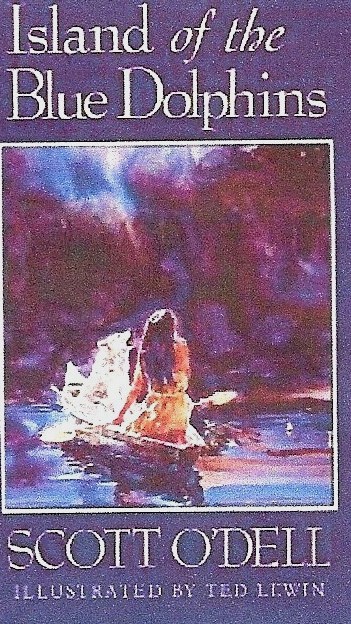
Island of the Blue Dolphins

by Scott O’Dell


#

The protagonist of Island of the Blue Dolphins opens the book with a remembrance of the day sea otter hunters landed on her tiny island home. It was a day that would mark the beginning of the end for her entire people.

Scott O’Dell’s novel attempts to give a name and memory to the girl who would become known to history as the Lost Woman of San Nicolas. By 1835, conflict with the otter hunters had nearly wiped out the Native American tribe living on one of the Channel Islands off the coast of California. When news of the catastrophe reached the mainland, the Santa Barbara Mission sponsored a ship to resettle the surviving people of the island the Spaniards had called San Nicolas.

But when the ship left the island, the woman later baptized as Juana Maria (given the name Karana by O’Dell) wasn’t on it. The explanation for this oversight died with her, but the novel follows a story narrated decades later, in which she jumped overboard as the ship left and swam back to the island. O’Dell explains her action as an attempt to rescue her younger brother.

She soon found herself alone on the island, her brother killed by wild dogs and the mission lacking enough ships for a second rescue attempt. The brother’s existence and death were among the few facts that could be gleaned when another ship finally found her eighteen years later.

Island of the Blue Dolphins ends with the rescued Karana hoping to reunite at last with her family. But her real story was to end tragically. Isolated for centuries, possibly millennia, on their island, the remaining members of her tribe soon succumbed to diseases for which they had no immunity. And attempts to locate anyone who could speak her language, even among other Channel Island natives, proved futile.

Juana Maria, her true name unknown, became fatally ill only seven weeks after arriving on the California mainland.

Island of the Blue Dolphins, a Newbery Award winner in 1961, is the best known of Scott O’Dell’s many novels for children and teens. Its simple language and muted emotional tone make bearable the otherwise horrific plight of the abandoned young girl.

Only I wondered, rereading it recently for the first time in decades, whether the tone might also have been O’Dell’s attempt to write something the culture of the time considered an “Indian” voice.

But that was the beginning of the tumultuous 1960’s. By the end of the decade, Kiowa author N. Scott Momaday’s House Made of Dawn won the Pulitzer Prize and the gates were opening to a renaissance of literature about Native Americans written by Native authors.

(Next Friday -- Young David Balfour searches for his sole living relative, only to find a miserly uncle who doesn’t mind selling him into indentured servitude in Robert Louis Stevenson’s Kidnapped.)