Showing posts with label Michael Merschel. Show all posts

Friday, May 19, 2017

Review: New kid in school -- science fiction as a guide to life

Review of: Revenge of the Star Survivors
Author: Michael Merschel
Publisher: Holiday House
Source: Purchase, Barnes and Noble
Grade: B

You don’t have to be the new kid in school to understand the protagonist’s plight in Dallas Morning News book page editor turned novelist Michael Merschel’s Revenge of the Star Survivors. If you’ve ever been the new hire, the new parent, the new homeowner, the new -- well, you name it -- you’ll get it.

Unfortunately, hero Clark (“like the explorer”) Sherman, who’s facing the first move, and first major trauma, of his young life, doesn’t get it. His parents think moving from their longtime home in Louisiana to Colorado for a job upgrade is a great idea. To Clark, it’s the end of the world as he knows it. Following the example of his favorite television show, Star Survivors, about a spaceship crew lost in the galaxy, he records his thoughts as entries in an astronaut’s log of a journey to an alien world, Planet Festus, aka Loretta T. Festus Middle School.

“We were hurtling across the planet’s surface, seconds away from the drop zone, when my commander spoke. ‘You really want to do this by yourself? You’re absolutely sure?’ The tiny crease between her eyebrows told me she was as worried as I was. ‘I’ll be fine,’ I replied. By which I meant, ‘No, I don’t want to do this at all. . . Please take me home immediately.’ Unfortunately, I sent that second part via psionic mind blast, forgetting that I was not technically capable of telepathy.”

The climate of Planet Festus proves hostile from the start, with its unfamiliar frozen ground and frozen precipitation. The inhabitants are equally hostile, particularly the one bearing a disconcerting resemblance to a “big, carnivorous reptile.” And the planet’s communications system is beyond primitive, having consigned Clark’s previous school records to the local equivalent of a black hole. Fortunately, among the few academic options available to him is Independent Study, which takes place in the school library, aka The Academic Resource Center.

There, at last, he begins to find allies – the aptly-named Ms. Beacon (“the commander of this zone”), and one of the school’s few Asian-American students, Ricki Roi (whose last name Clark misunderstands as “Wah”, a misunderstanding that stymies his attempts to communicate with her outside the classroom).

There’s also Les, an elusive, possibly wormhole dwelling student who will reveal dark secrets about Planet Festus and its leaders. The only thing uniting the disparate threesome of Clark, Ricki and Les: their mutual devotion to Star Survivors. Well, that and their resistance to the rest of Planet Festus.

On their journey through the planet they must deal with bullies, racism, and an evil ruling coalition determined to perpetuate its dynasty. The with whom they will clash in a dramatic conclusion. And as all middle schoolers do, the threesome must also deal with parents who seem initially clueless. At least in the case of Clark’s parents, they finally understand in the end.

This is why, as Clark records in his log, “. . . you should ignore anyone who tries to tell you that Star Survivors is an entertainment program. It is so, so much more. It is a guide to orderly behavior in a confusing world.”

(Unknown to Merschel, his mother had arrived from Colorado for his book’s debut. She was warmly supportive. He was slightly embarrassed that she might think the portrayal of the mom, aka commander, in his book was a portrait of her. Perhaps one day his own children, including two who were in middle school during writing, will write their own books about him. It’s the fate of parents and children.)

At his book’s release this spring at the Lincoln Park Barnes and Noble bookstore, Merschel insisted he didn’t even realize he’d written a middle grade book until others in the publishing business informed him who his audience was. Or who they thought it was. As someone who has dipped for the past thirty years into what my daughter and grandkids were reading, I can attest that good books for children have a universal appeal.

With so much good in Revenge of the Star Survivors, my major complaint is that in its determination to root out all evil from Planet Festus it feels over-stuffed, an over-richness that may have led to its too hurried for my taste climax, as if Clark/Merschel was either tiring of his long battle, or perhaps facing pressure from his publisher to get to the end. And although I initially bought the book intending it as a gift for my soon to be middle-schooler grandkids, I’m going to hold off transferring it for a while, for fear it might prove too terrifying for them. But given the state of life on Planet Earth, they may already be all too familiar with the terrain of Clark's world.

(Next week: summer literary events, contests, conferences, and a Dallas visit from internationally-bestselling Australian author, Kate Forsyth.)

Thursday, May 18, 2017

Review: Murder amid the books – an American in Paris

Review of: The Paris Librarian
Author: Mark Pryor
Publisher: Seventh Street Books
Source: Purchase, Half Price Books at Dallas Book Festival
Grade: B+

Texan (by way of Hertfordshire, England) Mark Pryor adds a locked room murder mystery to top all locked room mysteries to the latest in his Hugo Marston series with The Paris Librarian. Wealthy American ex-patriate Paul Rogers has a posh Paris apartment, a beautiful girlfriend, and a cushy job as head of a private library, where he’s holding a special book from the library’s sale for the benefit of his bibliophile friend, Hugo Marston.

Marston also happens to be head of security for the American Embassy and an ex-FBI agent. When Rogers fails to turn up with the book, is it Hugo’s cop instincts or booklust that push him to force an opening of the locked room in the library’s basement where Rogers has spent the morning writing?

The book is forgotten, however, when Rogers’ assistant produces his own key, to find Rogers dead. With no signs of violence, the initial presumption is that Rogers succumbed to a possible heart attack. But to Hugo’s eyes, something doesn’t look right. At least he can plead unfamiliarity with the French requirements for reporting death long enough to call the one person who’s always helped him in the past when dealing with the deaths of fellow countrymen on French soil – Lieutenant Camille Lerens.  

Camille, however, works for the Brigade Criminelle, the police division responsible for investigating the city’s most serious crimes. It takes all Hugo’s charm to persuade her to visit the scene of what seems most likely to be a natural death. Fortunately for Hugo’s and Camille’s friendship – and their professional reputations – an investigation reveals that the actual cause of Rogers’ death was an exotic poison – curare.

Unfortunately for Hugo’s reputation, the poison is only toxic when introduced into the victim’s blood stream, and there’s no mark on Rogers’ body that would have allowed the poison to penetrate his system.

Worse, the library’s security cameras reveal that no one other than Rogers himself entered the locked, windowless room in which he was found. True, his assistant left a book Rogers had requested for research in his writing outside the room, but the ever-helpful security cameras show only Rogers opened the door to retrieve the book, and then only after the assistant’s departure. The police briefly consider the possibility of a bizarre suicide, but the absence of punctures or scratches on the body rules out even that. So how did Paul Rogers die?

Mark Pryor
For a brief while, it appears that the library is dogged with bad luck, when a janitor also suffers a heart attack, but is revived by a helper’s knowledge of CPR.

Red herrings swarm through Pryor’s tale, the best being a journalist’s pursuit of an aging actress who served as a spy during the World War II occupation of France, and is rumored still to possess the dagger she used to silence a too-persistent Nazi officer.

Hugo’s friendship with the comely journalist – and her equally comely girlfriend – as well as a lovely French girlfriend of his own, give Pryor’s hero a chance to revel not only in Paris but other regions of the French countryside. I found myself checking off places I want to see, or revisit, in France, much as I did for London during the reading of Deborah Crombie’s Garden of Lamentations, reviewed at this site yesterday.

Just as American-born Crombie revisits the British Isles frequently to update her knowledge of the setting, Pryor is also a frequent visitor to France. Otherwise, he divides his time between writing and his own crime-fighting duties as an assistant district attorney for Travis County, Texas.

Shades of Agatha Christie-like poison know-how, a dash of intrigue and psychological insight added to Pryor’s knowledge of his locale add up to a fun add up to a cozy with just enough gore to satisfy the more hardcore mystery fans. But why, oh why, didn’t anybody talk to the janitor? Or the workman who might have been able to identify a possible subject making his (or her) escape after a subsequent murder? And will Hugo ever stop playing coy about what he does with the gun Pryor hints he carries?


(Tomorrow I tackle a book in a completely different genre, by another Texan, Dallas newspaper editor turned novelist Michael Merschel’s Revenge of the Star Survivors.)

Monday, October 13, 2014

Wordcraft -- What books do reviewers like best?

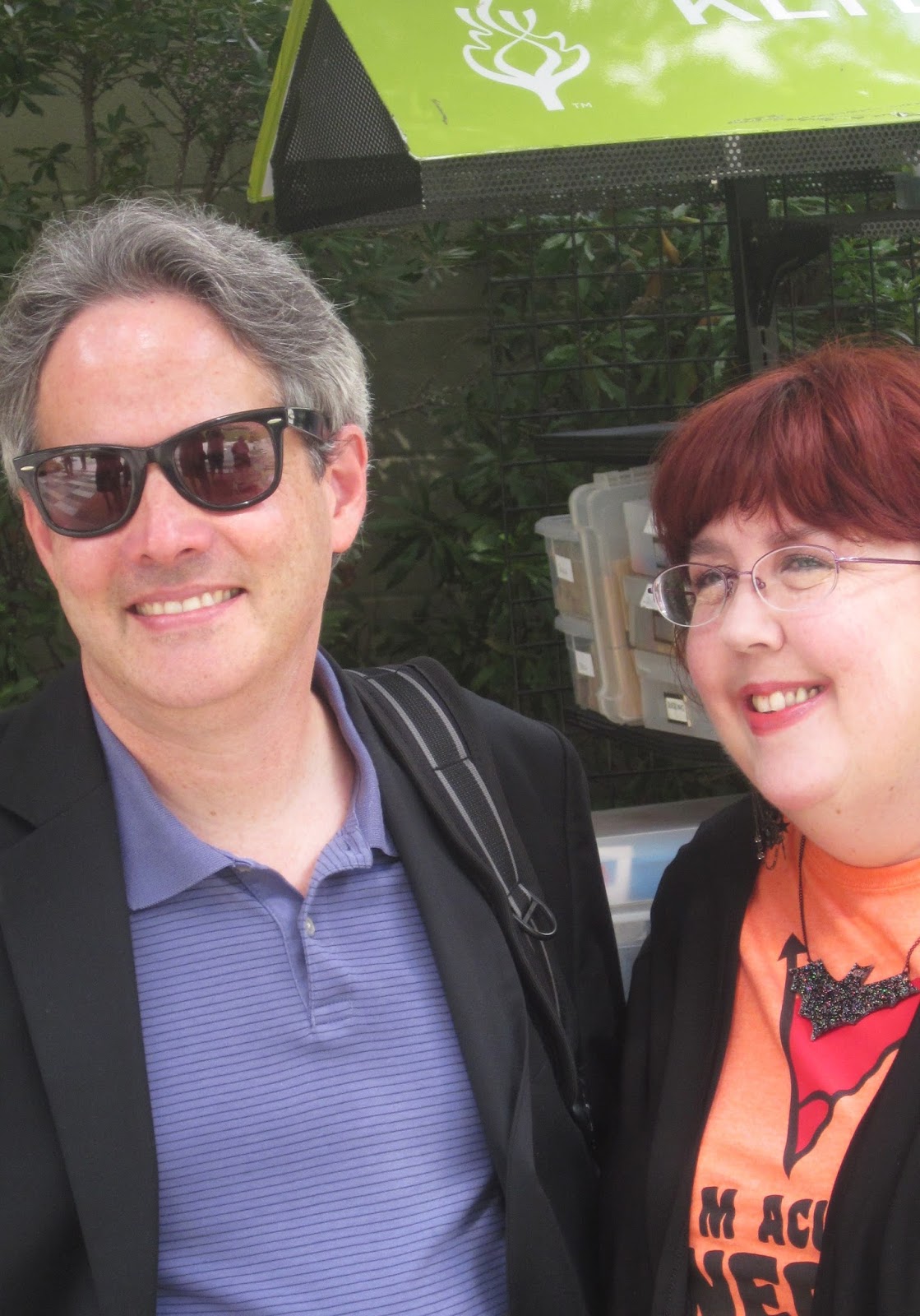
Merschel & Tipping
When I’m at the library, I always check out what’s on the carts waiting to be shelved. You know, the stuff other people read. So I was at Klyde Warren Park early last Thursday, joining several other book lovers. Because what we all wanted to hear was what Dallas Morning News book pages editor Michael Merschel and voracious reader/staff writer/reviewer Joy Tipping were reading.

“The Facebook game of the moment¾ or was it last moment? They go by so fast¾ has a nice literary twist,“ Merschel wrote in a recent column. “It asks you to fame five ot 10 books that meant something to you and then tag five friends and ask them to do the same.“

So it was, tag, Michael and Joy, and tell us about those five favorites for fall reading. And first, how they pick those favorites.

Given that the News receives approximately 300 books each week to review, picking five, even five with special appeal to Dallas readers, isn’t easy.

His first pick: Blood Aces by Doug Swanson, about Dallas gangster turned Las Vegas casino mogul Binny Binion. Merschel admitted the topic didn’t immediately appeal to him. But he read it and was hooked. “He get into a subject that history will never acknowledge ¼ Each time you think it can‘t get any more incredible, it does.”

Second pick: Merritt Tierce’s debut novel, Love Me Back, which Merschel describes as “Cormac McCarthy’s The Road, but set in a Dallas steakhouse.” Definitely now family friendly, he warned, but with a Dallas angle that may make readers think twice about which restaurant they choose: “the writer once worked in a steakhouse not far from here.”

And third pick? Walter Isaacson’s history of computers, The Innovators. Merschel’s only quibble about this¾ “he tells so many stories, I wished he’d focused on fewer.’ But when one story is about Etta Lovelace, the woman who invented the basis for computers in the 1840’s and the women who wrote the first computer programs in the 1940’s, who can pick which one to leave out?

At this point, Merschel relinquished the floor to Tipping. Or maybe Tipping just seized the chance to talk. Her first choice: another debut novel by a Dallas author, Minerva Koenig’s Nine Days. “I think this might replace the alphabet mysteries of Sue Grafton,” Tipping said, with its tale of a murder set in a tiny Texas town and an unlikely heroine close to her heart, “pushing forty, barely five feet tall, and round.”

Tipping’s second choice: “the funny and heartwarming” tale of sisters Iris and Ava, Lucky Us, by Amy Bloom.

Her third choice, for something completely different: David Quammen’s Spillover, now out in paperback, “about a virus coming out of the rainforest in Africa transfers to humans.”

Finally, considering that she’s a virulent fan of historical romance writer Diana Gabaldon, Tipping couldn’t resist a plug for Gabaldon’s Outlander series.

Which prompted Merschel to put in a final word for something again completely different, The Magician King, by Lev Grossman, last of his Magician trilogy. “It’s an allegory about his struggles with depression, but it’s funny and witty. I gave up reading fantasy books in about the 12th grade and this is the one that brought me back.”

And then, of course, there’s Merschel’s often-expressed admiration for YA author Judy Blume and her expression to readers that’s it’s “not about me. It’s about you, it’s about us. That’s the way I feel about the books coverage. It’s not Mike’s books, it’s not Joy’s books. It’s your book section.”

For more reviews from the Dallas Morning News, including many books mentioned in this post, see
www.dallasnews.com/entertainment/books/.